
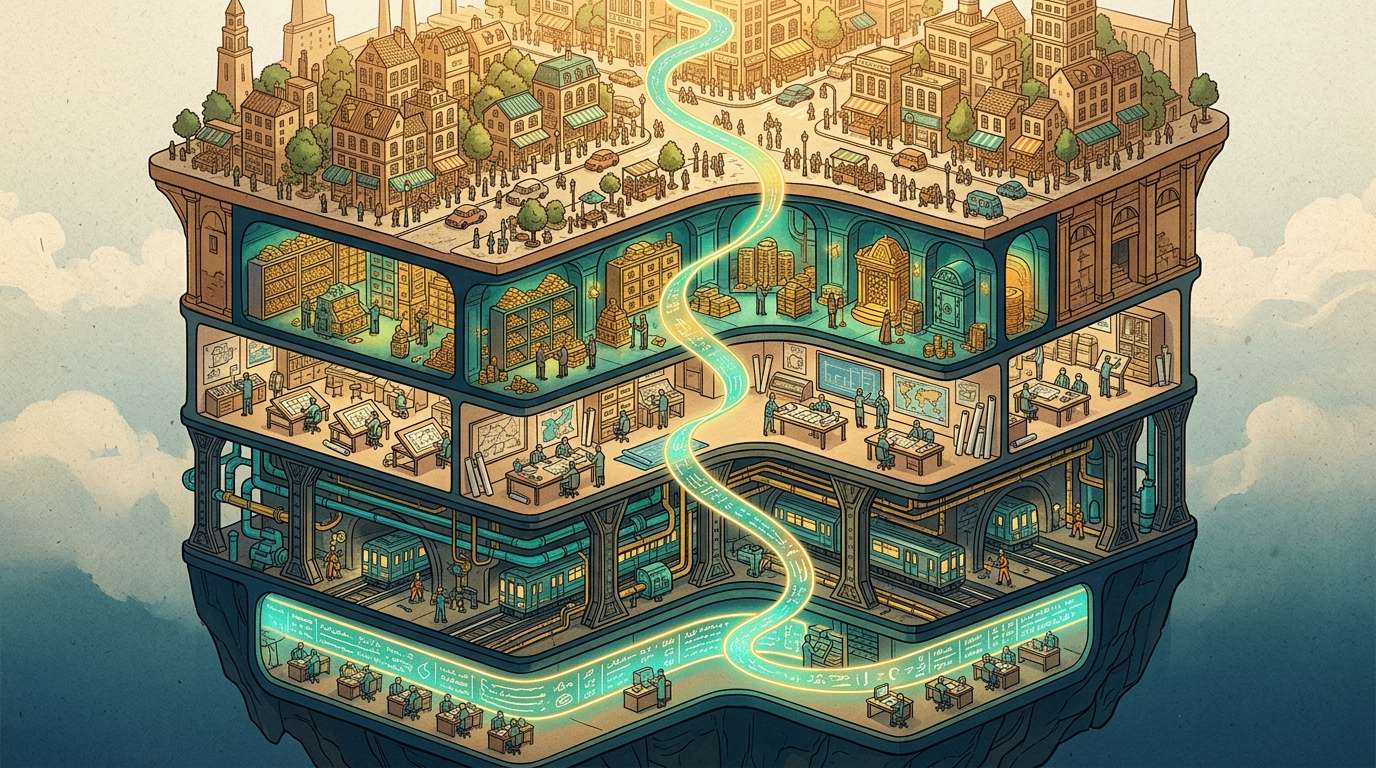
A decentralized autonomous organization, or DAO, is a group that coordinates through shared rules, a shared treasury and recorded votes, instead of through a boss and a head office. This post sets out the five layers every MyCity city is built on, and what each one has to do for the whole to work.
What a DAO actually is
Strip away the jargon and a DAO is three things: written rules that everyone can read, a common pool of money that no single person controls, and a record of every proposal and decision that anyone can check. “Autonomous” means the rules are followed by the system, not at someone’s whim. “Decentralized” means no single person holds all the control.
In practice, most DAOs also have people who do a great deal of the work, and MyCity is open about this. Rules and records can be decentralized while leadership is still clear. In MyCity’s model MyCity leads and keeps the final say, and the structure below is what keeps that accountable.
The five layers
How a decision moves through the layers
- A peer posts a proposal with a clear scope and cost.
- Peers discuss it and vote, one peer, one voice.
- MyCity reviews the outcome and makes the final decision, publishing its reasons.
- Funds are released in stages, tied to milestones, and each payment is recorded.
- The result is written back into the record, so the next decision starts from what really happened.
The legal reality of a DAO
A DAO is a technical and social structure. Law has not caught up with it everywhere, and recent cases show why this matters to anyone taking part.
In the Ooki DAO case, a US federal court accepted that a DAO can be sued as an association. That ruling was a default judgment, meaning nobody defended it, so its weight as precedent is limited. In the Lido DAO case, the court declined at an early stage to dismiss a claim that the DAO was a general partnership and that active participants might be liable. That was a procedural ruling, not a final verdict, and lawyers disagree about how far it reaches.
What MyCity takes from this. A DAO with no legal wrapper can leave participants exposed in some jurisdictions. That is why MyCity uses a published legal wrapper where law requires one, clearly defines roles, and explains risk plainly before anyone contributes. Sri Lankan law has no specific DAO status, so the wrapper is designed locally, with legal advice.
Where each layer can fail
- Peers: low participation means a few people make every decision.
- Pool: lost keys, a compromised signer or a mistaken transfer. Multi-signature custody reduces, but does not remove, these risks.
- Proposals: vague proposals that cannot be judged afterwards.
- Infrastructure: cost overruns and delays, as in any construction project.
- Record: records that exist but are not kept current, which is almost as bad as none.
Key takeaways. A DAO is rules, a shared treasury and a public record. MyCity builds each city on five layers: peers, pool, proposals, infrastructure and record. The structure makes decisions checkable, and it does not remove legal or practical risk.
Frequently asked questions
What is a DAO?
A decentralized autonomous organization: a group that coordinates through written rules, a shared treasury and recorded votes instead of a conventional head office.
Are DAOs legally recognised in Sri Lanka?
There is no specific DAO status in Sri Lankan law. MyCity plans a published legal wrapper where the law requires one, reviewed by qualified advisers.
Can DAO participants be held liable?
In some US cases courts have treated DAOs as associations or partnerships. Those rulings are limited and contested, which is why roles and risks are set out clearly.
Sources and further reading
- Fenwick: The legal landscape for DAOs, lessons from Lido DAO and Ooki DAO
- Baker McKenzie: Court holds DAO may be sued as a person (Ooki DAO)
- Definitive: How to manage a DAO treasury onchain
Continue the series
- Previous: The Anchor and the Commons: How Every Plot Is Shared
- Next: How the Peer Pool Works: Six Steps and a $50 Unit
- All parts of the P2P Pool Guide
- Related: The MyCity Model and Decentralized Ownership Model
Part 5 of 10 in the P2P Pool Guide. This series explains a design. Joining is not open yet, no returns are promised, and nothing here is investment advice.