
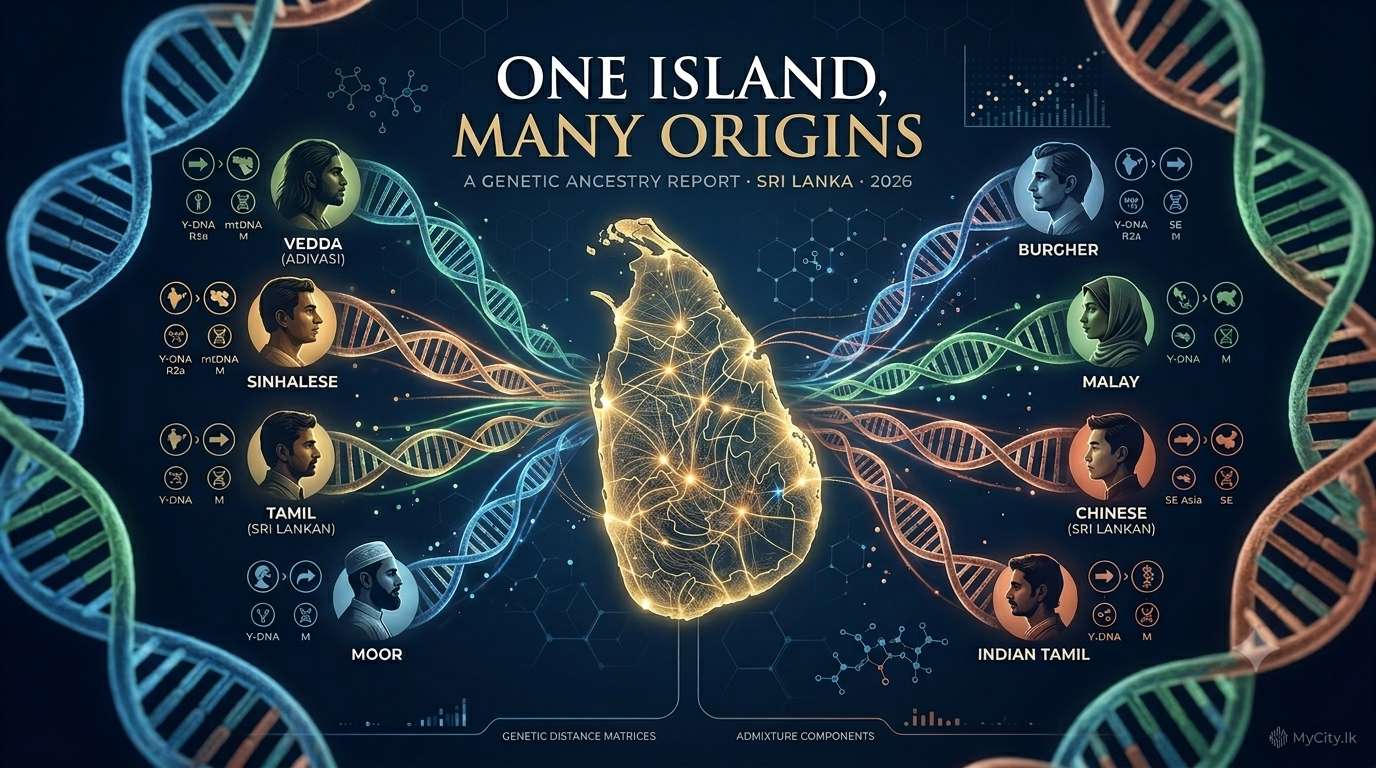
One Island,
Many Origins
A scientific journey through the DNA, haplogroups, and shared ancestry of every ethnic group that calls Sri Lanka home, told for everyone, not just scientists.
What is DNA, and why does it tell us who we are?
Before we explore Sri Lanka's ethnic groups, here is everything you need to understand what DNA ancestry actually means, in plain language.
Inside every cell in your body sits a complete set of instructions, your DNA. It contains roughly 3 billion "letters" that determine everything from your eye colour to how your body processes food. Crucially, DNA is inherited: half from your mother, half from your father. Over thousands of generations, tiny mutations (changes) accumulate. Scientists track these mutations to map where populations came from, how they migrated, and who they are related to. This is the basis of genetic ancestry.
Who arrived when, and from where
Sri Lanka has been continuously settled for at least 40,000 years. Every wave of arrival left a genetic trace still detectable today.
Native and non-native peoples of Sri Lanka
Each group's DNA tells a story of where they came from, who they mixed with, and what makes them distinct, and what unites them with everyone else on the island.
Where each haplogroup ultimately comes from
Every haplogroup is a branch on the human family tree. Here is where the key haplogroups found in Sri Lanka originated, and what their presence means.
| Haplogroup | Type | Geographic Origin | Age (approx) | Found in Sri Lanka | What it means |
|---|---|---|---|---|---|
| M | mtDNA | Eastern Africa / Arabian Peninsula | ~70,000 yrs | Vedda, Sinhalese, Tamil, Moor | The genetic backbone of the island. All M carriers share an ancestor who left Africa ~70,000 years ago on the "southern coastal route." The single most common mt haplogroup in South and East Asia. |
| R (mt) | mtDNA | South Asia / Near East | ~65,000 yrs | Vedda (45%), Sinhalese (7–25%) | Sister clade to M. Very ancient. Vedda's high R frequency reflects extreme antiquity, their ancestors carried this lineage before most South Asian populations formed. Also found in Australian Aboriginals. |
| U2 | mtDNA | South Asia (ancient) | ~50,000 yrs | Vedda, some Sinhalese | One of the oldest mtDNA lineages found in Mesolithic skeletal remains in Sri Lanka. Confirms Vedda direct descent from Balangoda-era populations older than 10,000 years. |
| H (mt) | mtDNA | West Asia / Middle East | ~25,000 yrs | Sinhalese, Moor (small %) | The most common haplogroup in Europe. Its presence in Sri Lanka arrived through ancient Near Eastern / Iranian Farmer ancestry that entered South Asia with agricultural expansion millennia ago. |
| H1 / H3 | Y-DNA | South Asia (ancient hunter-gatherers) | ~40,000–50,000 yrs | Vedda, Sinhalese, Tamil | One of the oldest Y-DNA lineages native to South Asia, associated with Ancestral South Indians (AASI). Also found in Roma people who migrated from India to Europe, showing the shared Indian root. |
| R2a | Y-DNA | South Asia / Central Asia | ~15,000–25,000 yrs | Sinhalese (~38%), Vedda, Tamil | Most common Y-DNA in Sinhalese men. Also high in West Bengalis and Roma people. Reflects ancient South Asian paternal ancestry shared across multiple populations on the subcontinent. |
| R1a1a | Y-DNA | Eurasian Steppe | ~5,000–8,000 yrs | Sinhalese (~13%) | The "Aryan marker", carried by Steppe pastoralists who spread Indo-European languages into South Asia. Its presence in Sinhalese confirms the Indo-Aryan migration. Also common in Brahmin castes and Eastern Europeans. |
| J1 / J2 | Y-DNA | Middle East / Levant | ~20,000–30,000 yrs | Moor (J1), Sinhalese, Tamil (J2) | J1 is strongly associated with Semitic/Arab populations, present in Moors' paternal lineages reflecting Arab merchant ancestry. J2 is found across the Middle East, Caucasus, and South Asia via ancient Iranian Farmers. |
| L1a | Y-DNA | South Asia / Indus Valley | ~15,000–20,000 yrs | Sinhalese, Vedda, Tamil | Associated with ancient Indus Valley populations. Found in many South Asian populations, connecting Sri Lankans to the ancient Indus civilisation's genetic legacy. |
| R1b | Y-DNA | Western Europe / Atlantic coast | ~10,000–20,000 yrs | Burghers (Portuguese/Dutch fathers) | The most common Y-DNA in Western Europe. Its presence in Sri Lanka is entirely due to European colonial men fathering children with local women, a clear genetic fingerprint of the colonial era. |
| O-M175 | Y-DNA | East / Southeast Asia | ~35,000 yrs | Malays, Chinese Sri Lankans | The dominant Y-DNA haplogroup across all of East and Southeast Asia. Found in Chinese, Japanese, Malay, Javanese. Its presence in Sri Lanka is entirely traceable to Malay and Chinese arrivals, absent from all other Sri Lankan groups. |
| B / F (mt) | mtDNA | East/Southeast Asia | Various | Malays, Chinese Sri Lankans | Austronesian/East Asian mtDNA lineages found in Malay and Chinese communities in Sri Lanka. Each marks a distinct non-South Asian ancestry thread carried by the island's Southeast and East Asian settlers. |
The ancient populations that mix in each group's DNA
Scientists compare modern DNA against ancient "reference populations" to calculate what proportion of each group's ancestry came from which ancient source. These are estimates from admixture modelling research.
How religion overlaps, but does not equal, ethnicity
Religion and ethnicity are deeply intertwined in Sri Lanka but they are not the same thing. The same DNA can be found across different faiths, and the same faith spans multiple ethnic groups.
Who is genetically closest to whom, and why
Genetic studies have compared all Sri Lankan groups against each other. Here are the key findings about genetic similarity and the shared threads that run through seemingly "different" communities.
Every person in Sri Lanka shares a common ancestor.
Science has proven it.
No matter how different Sri Lankan communities appear, in language, faith, culture, or history, their DNA tells a story of profound shared origin. All South Asian populations, including every Sri Lankan group except the Malays, carry a dominant thread of AASI ancestry, the Ancient Ancestral South Indians, hunter-gatherers who arrived in South Asia from Africa more than 50,000 years ago. The Vedda carry this lineage in its most pristine form. The Sinhalese, Tamils, and Moors all carry it too, blended with later arrivals. Even the Malays ultimately share the haplogroup O origin from East Asia, which in turn connects to the same Out-of-Africa migration that gave rise to all modern humans.
The DNA does not care about flags, languages, or holy books. It records only one truth: we are all one species, endlessly moving, mixing, and adapting across this small island and this vast planet.
Scientific studies behind this report
- Ranaweera et al. (2014), Journal of Human Genetics: mtDNA history of Sri Lankan ethnic peoples
- Population histories of Adivasi and Sinhalese using whole genomes, Current Biology (2025)
- Illeperuma et al. (2009–2010), Genetic profiles of Sri Lankan ethnic groups (STR loci)
- Mastana & Papiha (1996), Genetic variation in Sri Lanka (5 population groups)
- Kivisild et al. (2003), Genetic heritage of the earliest settlers in South Asia
- Sirisena & Dissanayake (2019), Genetics and genomic medicine in Sri Lanka
- Ranasinghe et al. (2015), Mitochondrial DNA polymorphisms in Sri Lankan populations
- Perera et al. (2021), Genetic analysis of Sri Lankan Moors
- X-STR genetic polymorphisms and demographic history of Sri Lankan ethnicities (PMC 2021)
- Sunday Times Sri Lanka, "Race in Sri Lanka: What genetic evidence tells us" (2014)