
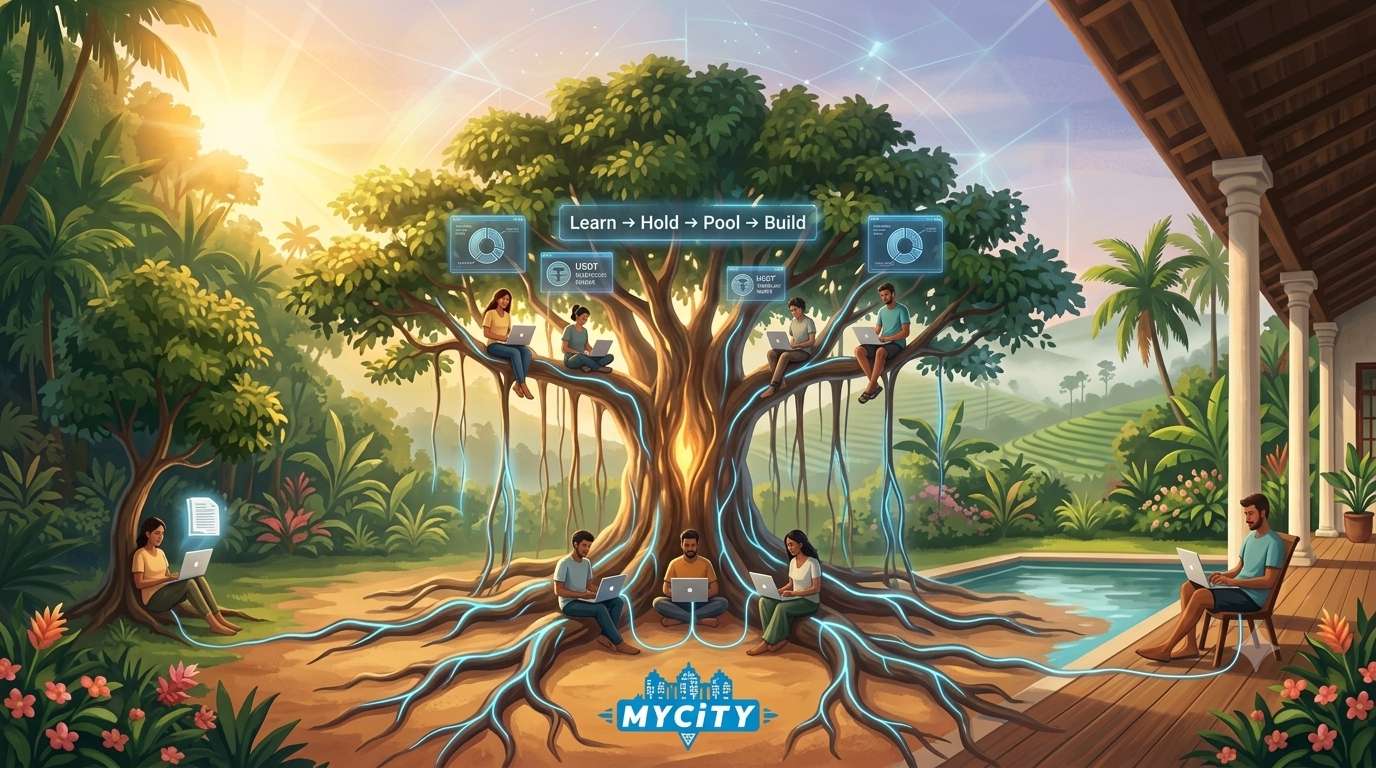
Why "How do I invest?" is the wrong question
We receive this question constantly. Someone hears about MyCity, a decentralized infrastructure layer for digital nomads, remote workers, and online founders, and their first instinct is to reach for the familiar playbook: find the founder, wire some money, own a slice of equity, wait for returns.
That model is not wrong. It is just a different game. It is the game of centralized companies, venture capital, and traditional business ownership. MyCity is playing a different game entirely, and the rules take a moment to understand.
The question "how do I invest in MyCity?" assumes MyCity is something you buy into from the outside. The correct frame is: how do I become a peer within MyCity's ecosystem? The difference is not semantic. It changes everything about what you do next.
The old model, and why MyCity moves away from it
In a traditional business, a founder raises capital from investors. Those investors own shares. The company grows (or doesn't), and returns (or losses) flow back through that ownership structure. It is held together by legal contracts and trust in institutions.
This model works. But it has a structural problem: the people closest to the value, the workers, the customers, the community, rarely own any of it. Wealth accumulates at the top of a pyramid, and participation is reserved for those who already had capital to deploy.
Digital nomads, remote workers, and online founders are scattered across centralized economies, paying taxes to countries they barely live in, depending on banks that exclude them, and building wealth for platforms they do not own. MyCity exists to give this community its own infrastructure layer.
Bitcoin, blockchain, and DeFi, explained simply
Before anyone can participate meaningfully in a decentralized ecosystem, they need to understand the tools it is built on. These are not complicated once you strip away the jargon.
Bitcoin, the first peer-to-peer money
Bitcoin is digital money that no single government or bank controls. It runs on a global network of computers, all of which independently verify every transaction. When you hold Bitcoin, you hold it directly, there is no bank in the middle that can freeze your account, inflate your savings, or restrict your access. This is the foundational idea: ownership without a gatekeeper.
Blockchain, a shared record book
A blockchain is simply a ledger, a record of transactions, maintained by thousands of computers simultaneously rather than by one central authority. Because everyone holds a copy, no single party can alter it secretly. This makes it possible to establish trust between strangers without needing a bank, a notary, or a government registry.
Stablecoins, digital dollars that don't swing wildly
Stablecoins are digital currencies pegged to a real-world currency, usually the US dollar, which means they hold a predictable value while still moving at the speed of the internet. A stablecoin lets you store value, send it across borders, and participate in financial pools without the volatility of Bitcoin or Ethereum.
DeFi, finance without banks
Decentralized Finance (DeFi) rebuilds financial services, lending, saving, pooling capital, without banks as intermediaries. Instead of depositing your money in a bank that pays you 1% interest, DeFi protocols allow peers to transact directly, with rules enforced by code rather than institutions.
MyCity's ecosystem is being built on these technologies. Understanding them is not optional background reading, it is the entry requirement for participation. A peer who does not understand the tools cannot make informed decisions about how to use them.
How MyCity actually structures ownership
MyCity operates as a Decentralized Autonomous Organization, a DAO. It is governed by its community of peers according to rules encoded in its infrastructure, rather than by a board of directors making unilateral decisions.
But MyCity also operates in the real world, where land has to be registered, companies have to be incorporated, and legal frameworks have to be respected. So it bridges the decentralized and the physical through a specific ownership structure.
The remaining 49% is distributed among up to 50 peers who participated in building the entity. The entity holds 0.5% back into MyCity, creating circular, aligned ownership across the entire ecosystem.
MyCity holds the majority stake in each real-world entity, not to extract profit, but to ensure continuity, accountability, and alignment with the broader ecosystem vision. Every entity's success strengthens MyCity, and MyCity's growth strengthens every entity.
What this looks like in practice
Take a concrete example: a cultivation entity, a peer-owned farm that produces food, employs local workers, and generates returns for its shareholders. Under the MyCity model, the journey from idea to incorporated entity looks like this:
The same structure applies to any entity, a co-working hub, a content studio, a renewable energy installation. The entity changes. The ownership architecture does not.
Investing in yourself first
MyCity is not asking you to trust it with your money. It is asking you to trust yourself enough to learn how to control your own money first.
Each step requires real knowledge. You cannot shortcut it by wiring money to a founder and hoping for the best. That would simply recreate the centralized model MyCity is designed to replace.
In a decentralized society, sovereignty comes before participation. You cannot be a genuine peer in a peer economy if you do not understand and control your own financial tools. MyCity's educational pathway is not gatekeeping, it is the prerequisite for meaningful ownership.
The goal is not 50 investors in a farm.
The goal is 50 sovereign peers who understand their money, control their assets, and choose to build something together, because they have the knowledge and the tools to do so. MyCity is building the infrastructure for that world, starting in Sri Lanka, extending across every city where people are choosing to live and work on their own terms. The entry point is not capital. It is knowledge. And knowledge, unlike capital, compounds in the person who holds it.