
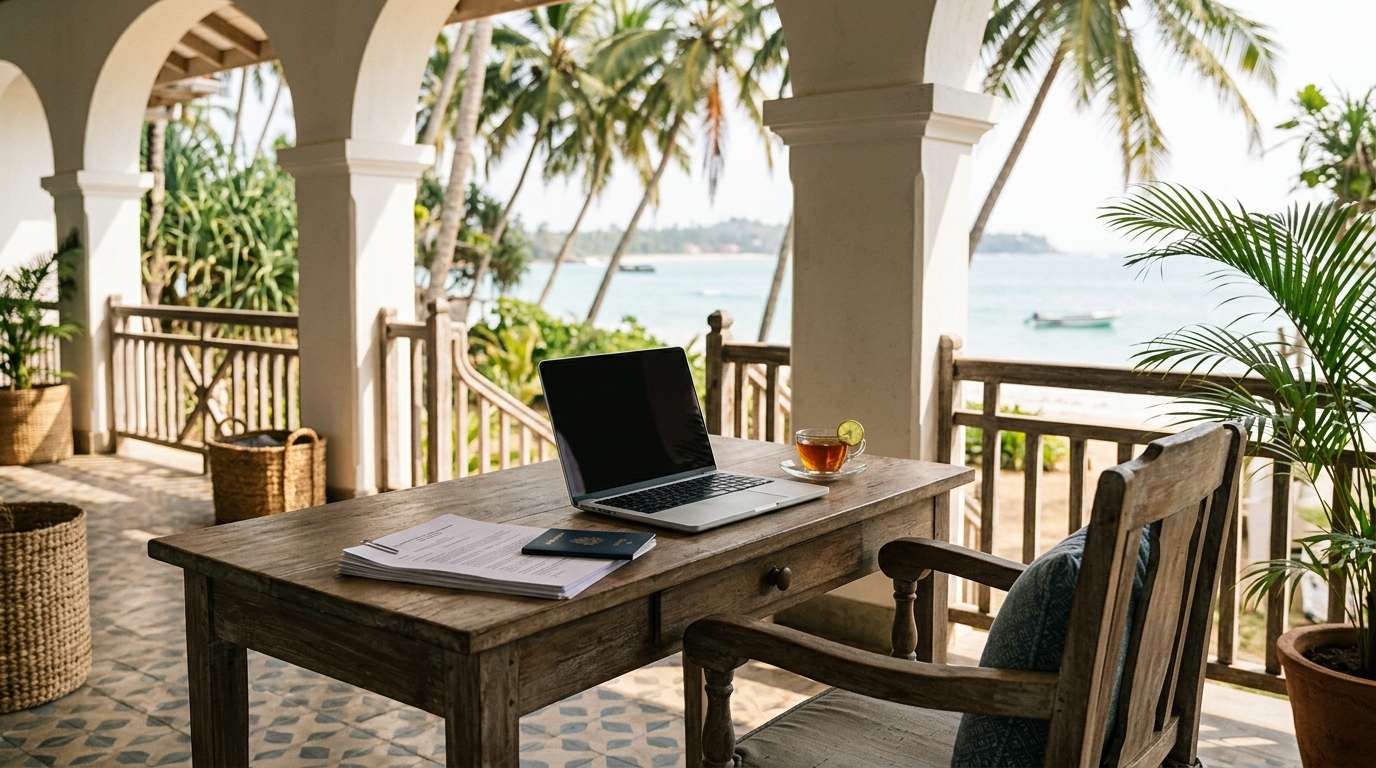
For years, foreigners working remotely from Sri Lanka lived in a gray zone. They arrived on tourist visas, extended them where they could, and left for a visa run when they couldn't. The work itself happened on a visa that was never meant for it.
That changed when the Department of Immigration and Emigration opened its Digital Nomad Visa category. The visa was approved by Cabinet in 2023, sat inactive for a long time, and was reactivated on 14 February 2026. The first one was issued on 26 February to a Ukrainian couple, with the tourism board launching a nomad promotion campaign alongside it.
This guide is built from the Department's own published rules. Where the official document is silent, such as processing times, we say so rather than guess.
// Eligibility
Who qualifies for the Digital Nomad Visa
The rules are short. The main applicant must be a foreign national aged 18 or over, and must earn from outside Sri Lanka in one of three ways:
The income test is a remittance test. You must send at least US$2,000 a month in foreign currency into Sri Lanka. With more than two dependents, add US$500 a month for each additional person. A family of two adults and three children, for example, needs US$2,500 a month arriving in Sri Lanka.
The visa does not let you work for Sri Lankan companies or earn from local sources. If your plan includes a local job, a Sri Lankan client or opening a local business, this is the wrong visa.
// Documents
The 12 documents you need
This is the Department of Immigration and Emigration's official list. Start with the slow items: the police certificate, the insurance and the ministry recommendation.
- Completed visa application form
- Request letter from the applicant
- Photocopy of your passport, valid for at least six months
- Two recent passport-size photographs
- Marriage certificate, if a spouse is applying
- Birth certificates, for each dependent
- Completed security clearance form
- Medical clearance report
- Police clearance certificate from your home country or country of residence, issued within the last three months
- International health insurance that covers medical care in Sri Lanka
- Recommendation from the Ministry of Digital Economy
- Proof of the minimum monthly remittance for you and your dependents
The three-month limit on the police certificate catches people out. Request it last among your home-country paperwork, so it is still valid when you submit.
// The process
How to apply, step by step
The official document lists three steps: submission, evaluation, and approval. In practice the work happens before submission. Combining the official steps with how law firms and immigration advisers describe the process, the order looks like this:
Immigration does not publish a processing time. Plan for several weeks between starting the ministry recommendation and holding the visa, and keep your tourist visa valid throughout.
// Cost
What the visa actually costs
The fee is US$500 per person, per year, charged to the main applicant, a spouse and each dependent separately. The fee is only part of the bill. Budget for these too:
- International health insurance that covers care in Sri Lanka, for every applicant
- Police clearance from your home country, plus any courier or translation fees
- Medical clearance in Sri Lanka
- A tourist or business visa to enter while the application is processed
Then there is the remittance itself. It is not a fee, since it is your own money, but it must arrive in Sri Lanka every month. Plan where it will land before you apply.
// Living on the visa
What the visa lets you do, and the rules you must follow
The Department lists six residency benefits. Visa holders can:
- Live legally in Sri Lanka for up to 12 months, renewable annually
- Open and keep personal bank accounts in Sri Lanka
- Sign property rental or lease agreements
- Enroll dependent children in international or private schools
- Get Sri Lankan telecom, internet and utility services in their own name
- Take part in coworking spaces, ICT programs and tourism events run by government or private organizations
In return, you must follow Sri Lanka's immigration, tax and other laws, stay out of political or disruptive activity, and earn only from foreign sources. If your job, income or dependents change, you must tell the Department within 30 days. Breaking any condition can lead to immediate cancellation.
If you want to end the visa yourself, the Department asks for two months' written notice, and 14 working days' notice if you are leaving Sri Lanka permanently.
// Year two
Renewing the visa and tax registration
To renew after your first year, you submit the same documents as the first time, plus proof of tax registration with the Inland Revenue Department. That is the clearest signal that long-stay nomads are expected to enter the Sri Lankan tax system.
Whether you owe tax in Sri Lanka, at home or both depends on your residency, your home country's rules and any tax treaty between them. Talk to a Sri Lankan tax professional before your first renewal, not after.
// Choosing a visa
Digital Nomad Visa or tourist visa?
If you are staying a few weeks, a tourist visa is simpler. The Digital Nomad Visa makes sense when you want to stay for months, work openly, sign a lease, bank locally or bring your family.
Once the visa is sorted, the next question is where to base yourself. Our note on building a remote work ecosystem in Sri Lanka covers what to check before you commit to a place, and the Galle and Mirissa guides cover the south coast. To get around cheaply once you're here, see buses, trains and routes that cost almost nothing.
The visa is real, the rules are clear, and the bar is reachable for most full-time remote workers.
The hard parts are timing and paperwork, not eligibility. Start the ministry recommendation and your police certificate early, keep your tourist visa valid while you wait, and decide where your monthly remittance will land before you arrive.
// Common questions
Sri Lanka Digital Nomad Visa: frequently asked questions
-
Does Sri Lanka have a Digital Nomad Visa?
Yes. The Department of Immigration and Emigration opened the Digital Nomad Visa in February 2026, and the first visa was issued on 26 February 2026. It lets foreign remote workers, freelancers and founders live in Sri Lanka for one year, renewable annually, while earning from clients or employers outside the country.
-
How much income do I need for the Sri Lanka Digital Nomad Visa?
The main applicant must remit at least US$2,000 a month in foreign currency into Sri Lanka. If you bring more than two dependents, add US$500 a month for each additional dependent. The requirement is a remittance, so the money has to arrive in a Sri Lankan bank account, not just exist abroad.
-
How much does the Sri Lanka Digital Nomad Visa cost?
The fee is US$500 per person per year. That applies separately to the main applicant, a spouse and each dependent, so a couple pays US$1,000 a year.
-
Can I apply for the Digital Nomad Visa from outside Sri Lanka?
Partly. You can request the Ministry of Digital Economy recommendation and gather documents before you travel, but reports on the process say applicants enter Sri Lanka on a tourist or business visa and complete the medical clearance in the country before submitting to the Residence Visa Division. Confirm the current procedure with immigration before booking.
-
Can I work for a Sri Lankan company on the Digital Nomad Visa?
No. Local employment is not allowed, and all income must come from foreign sources. You can serve overseas clients, work for a foreign employer or run a business registered outside Sri Lanka.
-
Do digital nomads pay tax in Sri Lanka?
Possibly. Renewing the visa after the first year requires proof of tax registration with the Inland Revenue Department, and long stays can make you tax resident. Get advice from a Sri Lankan tax professional and check your home country rules before you renew.
-
How long does the Sri Lanka Digital Nomad Visa take to process?
Immigration has not published an official processing time. Build in extra time for the Ministry of Digital Economy recommendation, which comes first, and for medical and security clearance.