
Why Sri Lanka Is the World's Next Great Remote Work Destination, And What We're Building to Prove It
Sri Lanka has the coastline, the culture, the cost of living, and now the visa. What it has been missing is a curated infrastructure layer that turns beautiful places into genuinely productive ones. That is the gap we are closing.
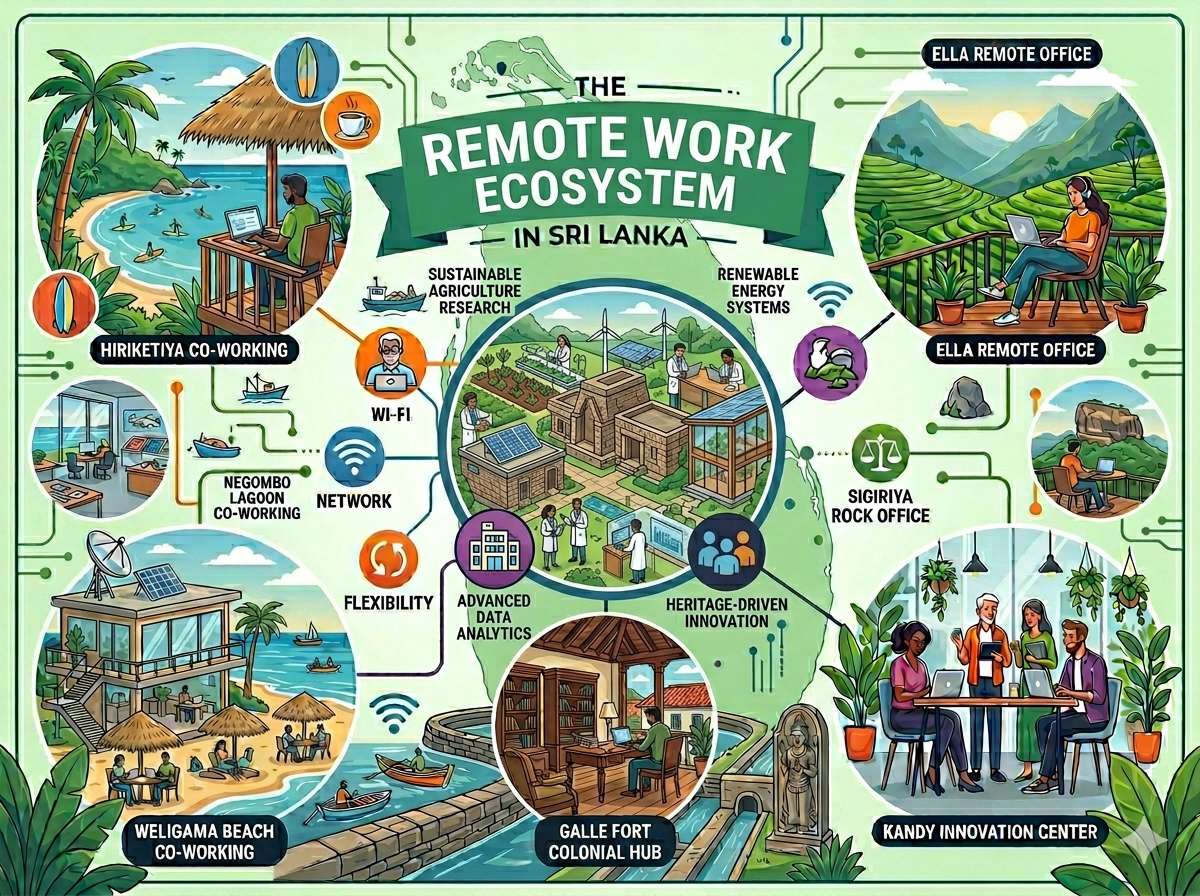
There is a version of remote work that the internet sold us, a laptop on a beach, a coconut, a sunset, forty-five minutes of actual productivity before the Wi-Fi dies and a power cut takes the router with it. Most people who have tried working remotely in a developing country know this version intimately. It is romanticised, frustrating, and fundamentally unsustainable for anyone doing real technical work.
And then there is the other version. The one that a small number of digital teams have quietly figured out, where the environment is not just beautiful but actually engineered for deep work. Where the internet does not go down during a client call. Where the backup power is not a prayer but a generator. Where the desk is a desk, not a sun lounger.
Sri Lanka can be that second version, at scale, for the first time. That is what we are building at MyCity.lk, and this post is our honest explanation of why we believe it, what the problem actually is, and what solving it looks like in practice.
Beautiful Country. Broken Infrastructure for Remote Teams.
Sri Lanka's appeal to remote workers is not a secret. The south coast, Weligama, Hiriketiya, Mirissa, is world-class surf territory. The Hill Country around Ella and Kandy offers a climate that feels nothing like the tropics. Colombo has the urban density and café culture that some teams need. The cost of living is, by global standards, remarkably low. And since the 2022 economic crisis, the country has been on a genuine recovery trajectory, with the tourism sector and the government actively signalling that international earners are welcome.
But if you try to bring a remote tech team here for a month, developers, designers, content producers, engineers, the friction becomes apparent quickly. The accommodation that looks stunning on Instagram has 10Mbps shared Wi-Fi that drops during rain. The "co-working space" is a café that closes at five. The power grid is still unreliable outside of Colombo. And finding a property that has genuinely vetted its internet, its power backup, and its working environment is an exercise in hope over evidence.
The problem is not that Sri Lanka lacks great places. It has an abundance of them. The problem is that great places and productive places are not the same thing, and for remote tech teams and content creators, only the latter actually works. Bridging that gap requires a standard, not just a recommendation.
Sri Lanka's Digital Nomad Visa Is a Genuine Opportunity
Before we get to what we are building, it is worth naming what has changed on the policy side, because it changes the calculus for anyone considering Sri Lanka seriously.
The visa solves the legal status problem that has historically made long-term stays awkward. Digital workers who previously had to do "visa runs" every thirty days now have a legitimate, renewable pathway to base themselves in Sri Lanka for a year or more. For companies running distributed remote teams, that is significant, it means staff can be here not for a sprint, but for a season or longer.
But a visa without the right infrastructure behind it is just paperwork. The people who will take this seriously are technical workers. They are not going to tolerate unreliable connectivity. That is the gap that needs filling, and filling it well.
$2,000+ Monthly Foreign Income
Provable income from outside Sri Lanka, employment contracts, freelance invoices, or verified remote earnings qualify.
12-Month Stay · Renewable
Initial approval for up to one year. Renewable annually for professionals who continue to meet the income threshold.
Families Welcome
The visa covers individual remote workers and their accompanying family members, a strong differentiator from many competing programmes.
Legal Remote Work Status
Full legal clarity for working remotely from Sri Lanka. No grey area. No awkward tourist-visa workarounds. Proper legal standing.
What "Nomad-Spec" Actually Means
We use the term Nomad-Spec internally to describe a standard rather than a vibe. It is the difference between a place that a remote worker could theoretically work from and a place that is actually engineered to support sustained, professional remote work. The distinction matters enormously in practice.
Nomad-Spec is not about luxury. Some of the best remote work environments we have encountered in Sri Lanka are modest properties run by local families who happen to have invested in the right infrastructure. And some of the most beautifully designed boutique hotels completely fail the standard because nobody ever thought to verify what happens to the connection when the neighbours are all streaming.
The Nomad-Spec Standard
5 hard requirements · No exceptions-
📡
Verified Fibre Internet, Minimum 50Mbps
Not "fast Wi-Fi." Verified, tested, and consistently delivered fibre with a real speedtest result attached. Includes information on the ISP, the router placement, and what happens during peak usage hours.
Hard requirement · No exceptions -
⚡
Generator or Solar Power Backup
Sri Lanka's grid is improving but not perfect. A property without documented power backup is not Nomad-Spec, regardless of how beautiful it is. Backup must cover the internet router, workstation area, and basic comfort cooling.
Grid backup required · Runtime documented -
🖥️
Dedicated Workstation Area
A proper desk at a proper height, with a proper chair. Separate from the sleeping area. With enough space for a second monitor if needed. This sounds basic because it is, and yet it eliminates most of the accommodation in Sri Lanka that markets itself at remote workers.
Ergonomic setup · Separate from bed -
🌡️
Climate Control in Work Zones
Air conditioning or reliable ceiling fans in the workspace. Sustained technical focus is not possible when ambient temperature is 34°C and there is no airflow. This is a coastal Sri Lanka reality that good properties account for.
Cooling in workspace verified -
🔕
Quiet Hours and Acoustic Separation
For video calls. For focus. For the reality that many of our team members are on calls with people in London, New York, or Singapore at hours that require concentration. Not a soundproofed studio, just a space that does not have a street market operating at the window.
Video call suitable · Quiet hours defined
The Locations We Are Betting On
Sri Lanka is not one destination, it is several distinct ecosystems, each with its own working character. We are not trying to cover all of them. We are deliberately concentrating on the locations that we believe have the highest potential for the kind of remote tech and creative work our team and partners do.
The most established nomad corridor in Sri Lanka. Strong café culture, growing co-working density, and a community of long-term remote workers who have been quietly making this work for years. Weligama is where the infrastructure is most developed, it is also where the standards vary most wildly between properties.
A smaller, tighter bay twenty minutes from Weligama with a character that feels genuinely different. Less developed, more intentional. The community that has formed around Hiriketiya tends toward the creative and the serious, people who came here specifically to do focused work in a beautiful setting, not to party.
The counterpoint to the coast. Ella and the broader Hill Country around it offer a climate that is genuinely different, cooler, clearer, with a quality of light and air that a surprising number of remote workers find more conducive to sustained technical focus than any beach. Also Sri Lanka's most photographed landscape.
An emerging R&D corridor anchored by Sri Lanka's ancient hydraulic heritage and surrounded by quiet, low-distraction terrain. Kalawewa offers the kind of deep isolation that serious research work demands, a place where long thinking cycles are possible and where the built environment does not compete with the work.
The shadow of the rock fortress provides more than atmosphere, it anchors a co-working and leisure circuit that is unlike anything else in the country. Sigiriya blends structured work environments with one of the most extraordinary natural and archaeological backdrops in South Asia, making it ideal for teams who want to combine output with inspiration.
Sri Lanka's cultural capital has long housed the country's second-largest concentration of technology talent, anchored by the University of Peradeniya and a maturing startup scene. The Kandy Innovation Center positions the city as a serious node in the national tech geography, connected, educated, and operating at urban scale without urban chaos.
Gateway city to the country and something more, a coastal research and development base that benefits from proximity to Bandaranaike International Airport without the density of Colombo. Negombo's fishing culture and lagoon geography provide a distinctive backdrop for teams who need connectivity to the world and the kind of coastal rhythm that supports longer, more sustained project cycles.
Each location requires a slightly different version of Nomad-Spec. The connectivity solutions in Ella are different from those in Weligama, mountain terrain means different ISPs and different backup strategies. Inland hubs like Kalawewa and Sigiriya present their own infrastructure considerations, while Kandy and Negombo operate at a scale where redundancy is more achievable. We account for that at the property level. The standard is consistent even when the technical implementation varies.
What This Does for Sri Lanka's Economy
We want to be honest about why we think this matters beyond our own team's comfort. The macro picture for Sri Lanka is one that makes verified corporate USD inflows genuinely significant, and this model produces them in a clean, documented, and scalable way.
When international remote teams base themselves in Sri Lanka through the Digital Nomad Visa, they spend locally, on accommodation, food, transport, services. That spending is in hard currency, and it enters the local economy directly through the bank accounts of local hospitality and service providers. It does not pass through informal channels. It does not get lost in remittance fees. It arrives as verified, B2B corporate revenue into Sri Lankan commercial bank accounts.
Every verified corporate USD payment into a Sri Lankan hospitality partner's bank account is a contribution to national net foreign assets. At the individual level, it is a room booking. At the aggregate level, hundreds of remote workers, dozens of partner properties, year-round occupancy, it is a material contribution to the FX reserve picture that Sri Lanka's recovery depends on.
Sri Lanka does not need more tourists who come for a week and leave. It needs long-stay, high-earning international professionals who integrate into local communities, spend consistently, and contribute to the kind of economic activity that compounds. The Digital Nomad Visa is the policy instrument. The Nomad-Spec infrastructure network is the delivery mechanism.
How Clean USD Reaches Sri Lankan Partners
Corporate Payment FlowInternational Remote Team Budgets Accommodation
A distributed tech team or content creator allocates a defined monthly travel and accommodation budget, denominated in USD, for their Sri Lanka residency period.
Booking Made Against Nomad-Spec Verified Properties
The property is selected from our verified network, confirmed fibre, confirmed power backup, confirmed workstation setup. The booking reflects the property's own publicly set room rate. Market rate. No ambiguity.
Standard Corporate B2B Payment to Sri Lankan Partner
The hospitality partner receives a clean, documented USD corporate payment directly into their Sri Lankan commercial bank account, Commercial Bank, Sampath, HNB, or equivalent. Standard international wire. No crypto. No informal channels.
Hard USD Enters Sri Lanka's Banking System
The partner's PFCA or foreign currency account receives the USD. Net foreign assets improve. Local staff get paid. The property invests in further infrastructure upgrades to maintain Nomad-Spec certification. A virtuous cycle begins.
The Content Layer, Why This Also Builds the Market
There is a second dimension to what we are building that is worth naming: the content side. Beautiful Nomad-Spec properties in Weligama, Hiriketiya, and Ella do not market themselves well. They are often run by brilliant local families who are exceptional at hospitality and entirely uninterested in Instagram strategy. That is fine, it is not their job.
It is, however, ours.
As part of how we operate, we work with a group of contracted global content creators, people whose job is to document what working and living in these locations actually looks and feels like. Not the fantasy version. The real version, the morning light through the villa windows while a video call runs flawlessly on a fibre connection, the afternoon surf break, the evening in a local restaurant where the bill for four people is twelve dollars.
This content does something that a marketing budget cannot replicate easily: it builds authentic demand from the exact audience we want to attract. Other remote tech workers and content creators who see someone they follow actually working productively from Hiriketiya are far more likely to try it themselves than they are to respond to any advertisement.
"The goal is not just to build infrastructure for remote work in Sri Lanka. It is to make Sri Lanka the obvious answer when a distributed tech team asks where they should spend the next three months."
— MyCity.lk · Founder's NoteA Vision Worth Building Toward
Sri Lanka as a Tier-One Remote Work Nation
The countries that will win the next decade of global talent are not necessarily the ones with the biggest economies or the most established tech scenes. They are the ones that solve the infrastructure, legal clarity, and community problem for the people who have already chosen to work from anywhere. Sri Lanka has a real opportunity to be one of those countries, a destination that serious remote workers choose not because it is cheap, but because it is genuinely excellent. We are building toward that version of Sri Lanka. One verified property at a time.
This is a long game. The properties we are vetting now, the standards we are establishing now, the content being created now, all of it compounds. A hospitality partner who upgrades their fibre and installs a generator because Nomad-Spec certification matters to them is now a better business for every guest, not just our teams. The standard spreads.
We are at the beginning of this. The network is small. The vision is large. If you run a property in Weligama, Hiriketiya, Ella, or anywhere else in Sri Lanka that you believe genuinely meets, or could meet, the Nomad-Spec standard, we want to hear from you. And if you are a remote tech team, a distributed startup, or a content creator considering where to base yourself this year, Sri Lanka deserves to be seriously on your list. If you want to understand the ownership model behind MyCity, and why we build peers rather than accept investors, the full explanation is in our piece on the decentralized ownership model.
Common Questions
$2,000/month income12-month renewableFamilies eligible
🏄 Weligama🌊 Hiriketiya🏔️ Ella🌆 Colombo
50Mbps+ fibrePower backupDedicated workstationA/C verified
Villas · Guesthouses · HotelsSite review conductedUpgrade path available
Hard USD into banking systemNFA improvementNo informal channels