
Why your current savings are working against you
Before the Seetu Mechanism makes sense, one idea needs to land first: fiat currency is designed to lose value over time. Every year you hold money in a traditional bank account, inflation quietly reduces what that money can actually buy. This isn't a bug, it's how the system is built.
Central banks control money supply. Governments print more when they need it. The result is a currency that depreciates steadily, and a savings culture that rewards spending over holding. If you're earning in rupees, dollars, or pounds and keeping them in a savings account, you are, in effect, running backwards.
The chaos we see in the world, financial mismanagement, widening inequality, populations cut off from wealth-building, is not accidental. It is the direct result of a world split between people who understand the financial system and people who don't. The Seetu Mechanism exists to close that gap. Not with a product. With education that permanently changes how you see money.
The core insight: Inflationary currency punishes savers. Deflationary assets, like Bitcoin and select crypto tokens, are built to appreciate over time as supply is fixed or decreasing. The Seetu Mechanism teaches you to move between these systems strategically.
// Layer 01, Individual
Becoming your own bank
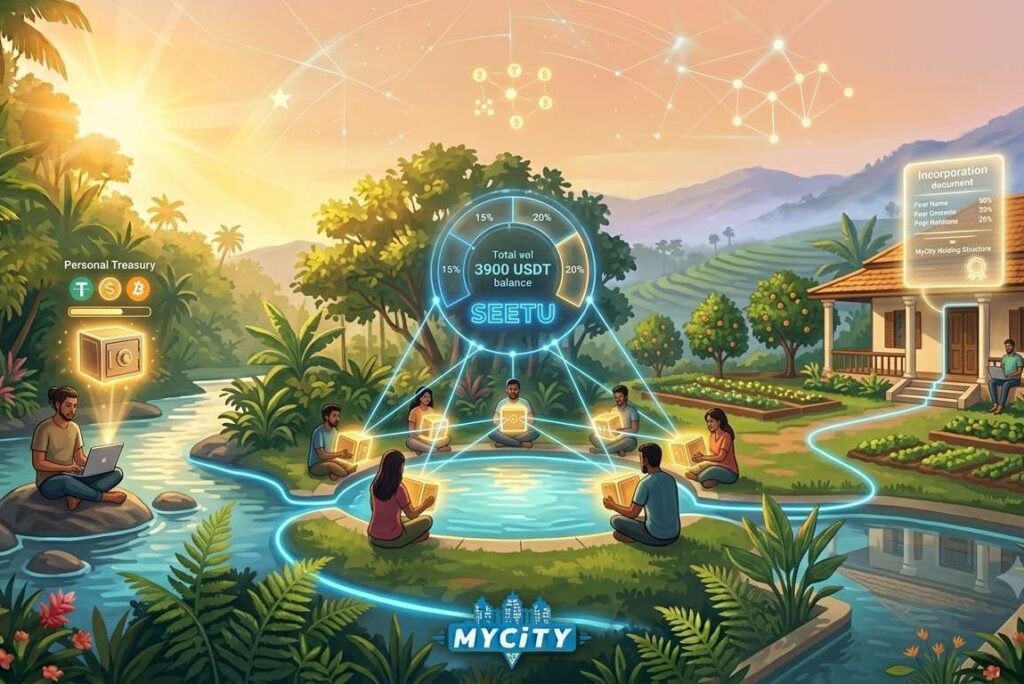
The first layer of the Seetu Mechanism is entirely individual. No pool, no peers, no company yet, just you, learning how to hold and grow your own capital outside the traditional banking system.
You start with stablecoins, cryptocurrencies pegged to a stable value, typically the US dollar. You get blockchain infrastructure (self-custody, transparency, borderless transfers) without the volatility of assets like Bitcoin. On a monthly basis, you buy a fixed amount. Disciplined. Recurring. Like a salary deduction, but going directly into an asset you control.
Once you're comfortable, you begin allocating a portion into appreciating assets, tokens with real utility, long-term demand, and fixed or deflationary supply. Over time, these holdings compound. You're not speculating; you're building a personal treasury. And when that treasury starts generating ROI, you're ready for the next layer.
✓ Key principle: You don't enter the P2P pool until you understand and own your individual layer. The collective is only as strong as the individuals within it, and every member of a Seetu pool has completed the education layer first.
// Layer 02, Collective
The P2P pool: saving together toward something real
Once you're generating returns as an individual, the Seetu Mechanism introduces the collective layer, the P2P pool. This is where individual financial progress becomes collective financial power.
The concept of seetu is ancient. Rotating savings groups, known as chit funds, susus, tandas, or seetu depending on the culture, have existed for centuries. A group of peers contributes regularly into a shared pool. Trust and discipline are the engine. The Seetu Mechanism takes this logic and rebuilds it on blockchain infrastructure, transparent, trustless, and community-governed.
But unlike a traditional rotating savings group, the Seetu P2P pool has a defined destination. The pooled ROI isn't just redistributed among members. It is accumulated toward a specific, structured goal: the incorporation of a real company.
⚠ Important distinction: The Seetu Mechanism is not a high-yield investment scheme or a promise of returns. It is a structured savings and growth framework built on education, discipline, and collective participation. Your capital is always yours, and the company you help build will be legally yours too.
// Layer 03, The Company
The incorporated company: from pool to real business
This is the layer that makes the Seetu Mechanism unlike anything else in the savings or crypto space. When a group of educated peers has pooled sufficient capital, MyCity helps them incorporate a real company, a registered LLC with a legal identity, a traditional bank account, formal shareholding, and full operational legitimacy within today's centralized governance systems.
This is not a DAO. It is not a crypto wallet. It is a real business, with real legal standing, that can operate in the world as it exists today, while simultaneously holding a portion of its funds in crypto infrastructure connected to tomorrow.
// Ownership structure
// Incorporated company, shareholding breakdown
MyCity holds 51%, providing the governance framework, operational rules, CopyTrade infrastructure, and strategic direction. The remaining 49% is split equally among 49 individual peer shareholders: people who started with no investment knowledge, learned the fundamentals, built a personal treasury, and pooled their way into real company ownership.
Each peer owns approximately 1% of a real incorporated company, built from the ground up, through education and discipline, by people who the financial world had previously left behind.
// Dual financial infrastructure
The incorporated company operates across two financial rails simultaneously:
A traditional bank account, fully centralized, legally compliant, capable of operating within every existing regulatory system. The company can pay vendors, receive revenue, sign leases, and operate exactly like any other registered business.
A crypto account, holding a designated portion of the company's funds, connected to MyCity's CopyTrade mechanism. MyCity operates as the master trader. The company's crypto allocation mirrors those trades automatically, generating monthly returns without requiring any member to actively trade.
The result is two income streams feeding the same long-term mission, business revenue from operations, and CopyTrade returns from the crypto allocation. Both compound simultaneously. Both flow back into the company and ultimately into the MyCity infrastructure network.
// Layer 04, The City
A chain of companies, city by city
MyCity does not build one company. It builds a chain of incorporated companies, each focused on one infrastructure vertical in one city. A city requires multiple systems to function, accommodation, food, healthcare, transport, energy. Each of these becomes its own entity, in each city, over time.
Each company generates revenue from real operations, accommodation bookings, food services, transport fees. A portion of that revenue flows back to MyCity as the parent company, funding the next entity, in the next city, in the next vertical. The chain is self-funding by design.
For the digital nomads and remote workers who move between these cities, the network becomes invisible infrastructure they simply live inside, accommodation they trust, food they can find, transport they can rely on. Built by peers like them. Partially owned by peers like them.
// The complete picture
How the full flywheel works
// Seetu Mechanism, complete flywheel
Education
Individual learns fiat vs. crypto fundamentals. Financial literacy becomes a permanent shift, not a course, a new way of seeing money.
Personal Treasury
Monthly stablecoin purchases + allocation into appreciating tokens. Individual ROI begins compounding. The person becomes their own bank.
P2P Pool
ROI flows into the collective peer-to-peer pool. Transparent, trustless, community-governed. Capital accumulates toward incorporation.
Company Incorporated
49 peer shareholders + MyCity (51%) register a real LLC. Legal bank account. Formal shareholding. Operational in today's centralized world.
CopyTrade Activated
Company allocates a portion of funds to crypto. MyCity's CopyTrade generates monthly returns automatically. A second income stream on top of business revenue.
Infrastructure Built
Company operates one vertical in one city, accommodation, food, transport, energy. Revenue funds the next company in the chain.
Chain Expands
New companies in new cities, new verticals. Revenue flows back to MyCity. The ecosystem becomes self-funding and self-sustaining.
Decentralized City
Members live and work inside infrastructure they helped build and partially own. New individuals enter at Step 01. The flywheel continues.
The goal was never just to save money. It was to build the infrastructure of a life that doesn't depend on systems you don't control.
The Seetu Mechanism is the financial engine of that life. Education at the individual level. Collective power at the pool level. Real company ownership at the incorporation level. And at the city level, accommodation, food, transport, and energy that you helped build, that you partly own, and that serves you wherever you go. This is what peer-owned decentralized infrastructure actually looks like when it starts from the ground up.
// Common questions
Frequently asked questions
-
What is the Seetu Mechanism?
The Seetu Mechanism is MyCity's peer-to-peer savings and growth system. Individuals learn crypto fundamentals, build personal savings in stablecoins and appreciating tokens, pool their ROI collectively, and ultimately co-found a real incorporated company, 49% owned by peer shareholders, 51% by MyCity, that builds decentralized infrastructure services city by city.
-
What is the incorporated company in the Seetu Mechanism?
It is a registered LLC formed by a group of peers who have completed the Seetu education layer. It has a legal bank account, formal shareholding documentation, and full operational legitimacy within centralized governance. A portion of its funds are allocated to a crypto account connected to MyCity's CopyTrade for monthly trading returns.
-
How is the company owned?
51% is held by MyCity, which provides governance, operational framework, and strategic direction. The remaining 49% is split equally among 49 peer shareholders, individuals who built their stake through the Seetu savings mechanism, starting from zero financial knowledge.
-
Do I need to be a crypto expert to participate?
No. The Seetu Mechanism starts with education. You learn fundamentals before deploying any capital. The system is designed so that expertise lives at the MyCity level and benefits flow to members, not the other way around.
-
What infrastructure does the company build?
Each incorporated company focuses on one vertical in one city, accommodation, food, healthcare, transport, or energy. MyCity builds a chain of these companies across cities, each generating revenue that flows back to the parent and expanding services available to digital nomads and residents.