
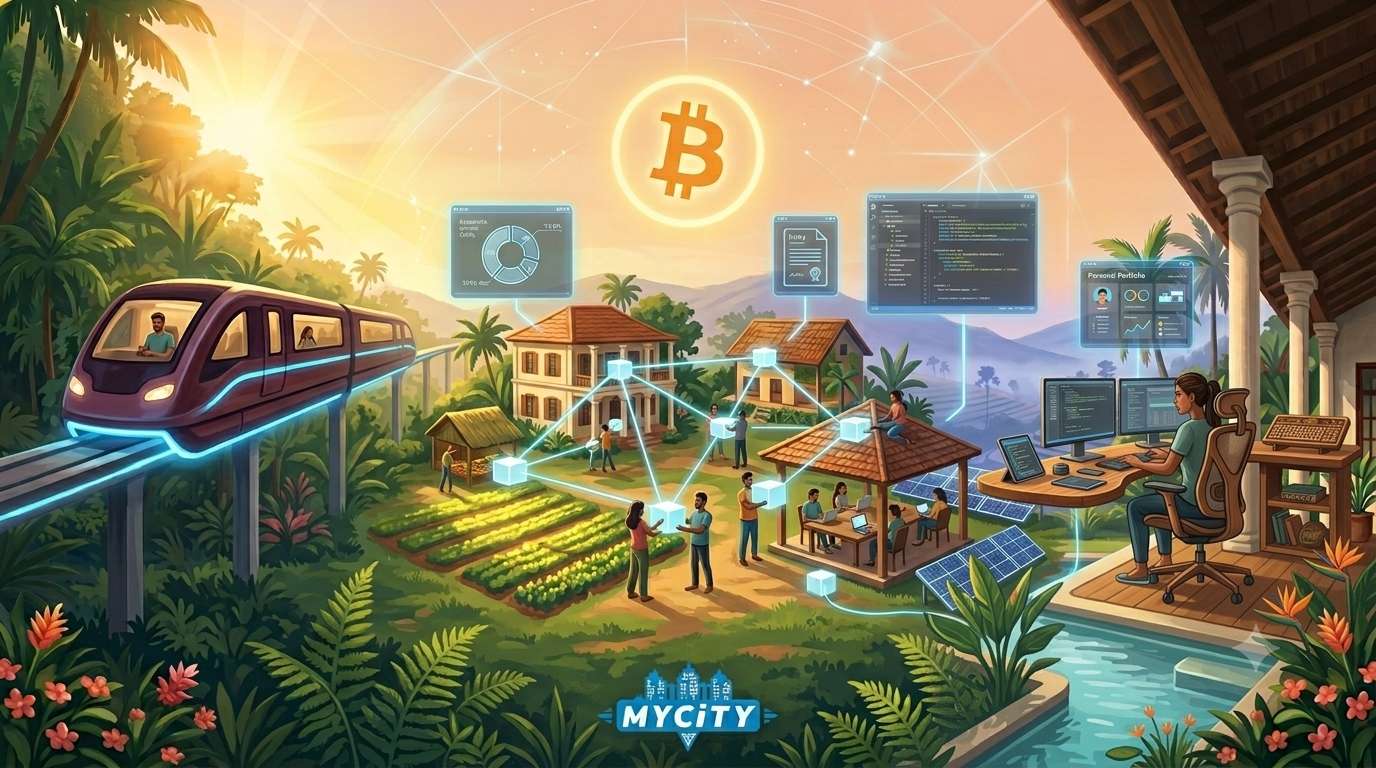
Everyone is building a Bitcoin city. What does that actually mean?
The phrase "Bitcoin city" has been claimed by governments, crypto communities, and venture-backed urban experiments. El Salvador's Bukele announced it at a beach concert. Ljubljana's BTC City branded a shopping mall. Chiang Mai's Bitcoin community jokingly started calling their city a "secret Bitcoin city" because of its dense community of Bitcoin users paying for coffee with Lightning.
These are all real. They are all different. And they share one thing: they use Bitcoin as a monetary layer, a store of value or medium of exchange, while the city infrastructure around them remains largely conventional. Land is still registered through governments. Companies are still structured through traditional law. Community ownership is still an aspiration, not an architecture.
MyCity is not building a Bitcoin city by convincing a government to adopt Bitcoin. It is building decentralized city infrastructure that runs on Bitcoin principles: peer-to-peer ownership, no central gatekeeper, and value distributed to the people who build it, not the people who fund it from the outside.
The three Bitcoin city models, compared honestly
Before explaining the MyCity model, it is worth understanding what the dominant approaches to building a Bitcoin city actually look like, and where each one hits a structural ceiling.
| Model | Example | Bitcoin role | Who owns the infrastructure |
|---|---|---|---|
| Sovereign city | El Salvador's Bitcoin City | Legal tender + energy | Government |
| Community hub | Chiang Mai, Zug | Medium of exchange | Existing businesses |
| Branded district | BTC City Ljubljana | Brand identity | Private developer |
| Peer-owned network | MyCity.lk | Monetary standard + P2P pools | Peer shareholders |
The first three models are real achievements. But each one hands ownership to a single authority, whether a government, an existing merchant class, or a private developer. The people who live and work in these cities participate as residents and customers, not as co-owners. That is the gap MyCity is designed to close.
Bitcoin is the monetary layer. Infrastructure is the hard part.
Bitcoin's contribution to any city is not primarily its price. It is its properties: fixed supply, permissionless access, no central authority, global settlement without a banking intermediary. These properties make Bitcoin the ideal monetary standard for a community that does not want to depend on a single government's currency or a single bank's permission to transact.
But a monetary standard, on its own, does not build a city. Cities are infrastructure: places to live, food to eat, fibre to work on, co-working spaces, farms, logistics, energy. A community holding Bitcoin still needs all of these things. And if it acquires them through conventional means, it is simply a Bitcoin-holding community living inside conventional city infrastructure owned by someone else.
The question no Bitcoin city has fully answered yet is: how do you build the physical infrastructure of a city on the same peer-to-peer, decentralized principles as the money? That is the question MyCity is building toward an answer to.
How to build a Bitcoin city, peer by peer
MyCity's approach to decentralized city infrastructure is not theoretical. It is a specific, replicable structure that turns educated peers into shareholders in real-world entities, which together form the physical infrastructure of a city that runs on Bitcoin principles.
The building block is not a government bond or a venture capital round. It is the peer-to-peer pool: a group of individuals who educate themselves, hold their own stablecoins, and collectively incorporate as a registered company to build or acquire a piece of physical infrastructure.
How ownership is structured across the network
The ownership model is the same across every entity in the MyCity network. MyCity holds the majority stake to ensure continuity and accountability. The remaining 49% is distributed among the peers who built the entity. And every entity holds a small stake back in MyCity, creating circular, aligned ownership across the entire ecosystem.
The remaining 49% is distributed among up to 50 peers who participated in building that entity. Every entity's success strengthens the network. The network's growth creates more entities for the next group of peers to build.
This structure replicates itself. Each entity is legally independent, locally compliant, and peer-owned. But each is also a node in a network that shares governance principles, economic tools, and a common monetary standard. That is what makes it a city, rather than a collection of separate businesses.
Sri Lanka is not an arbitrary starting point. It offers the cost structure, the visa framework, the coastline, and the community of digital nomads and remote workers that makes peer-owned city infrastructure viable at small scale first. The model that works in Galle or Ella can be replicated in any city where the conditions are right. Sri Lanka is the proof of concept. The world is the market.
The Bitcoin standard, applied to physical space
Bitcoin's core properties are not just monetary principles. They are organizational principles. Fixed supply means no dilution. Permissionless access means no gatekeeper. Peer-to-peer means no intermediary extracting value between participants. Verification over trust means the rules are encoded, not promised.
MyCity applies each of these principles to the way it builds physical infrastructure. The peer-to-peer pool has no fund manager extracting fees. The ownership structure has no insider allocation or founder's equity cliff. The DAO governance means rules are encoded in the structure, not dependent on any single person's decisions. The stablecoin settlement layer means value moves between peers without a bank in the middle.
A city built on Bitcoin principles does not just use Bitcoin as money. It uses Bitcoin as a design specification: decentralized, peer-owned, permissionless, and governed by code rather than by gatekeepers. Every MyCity entity is built to this standard. The city that emerges is, by architecture, a Bitcoin city.
A city is not a building. It is a network.
El Salvador needed a volcano and a presidential decree to announce its Bitcoin city. Bhutan needed 10,000 BTC and a royal mandate. MyCity needs something more available and more durable: educated peers who understand their tools and choose to build together. The network starts in Sri Lanka. It extends to every city where people are choosing to live and work on their own terms. One entity at a time, one peer at a time, the infrastructure compounds. That is how you build a Bitcoin city without waiting for permission.