
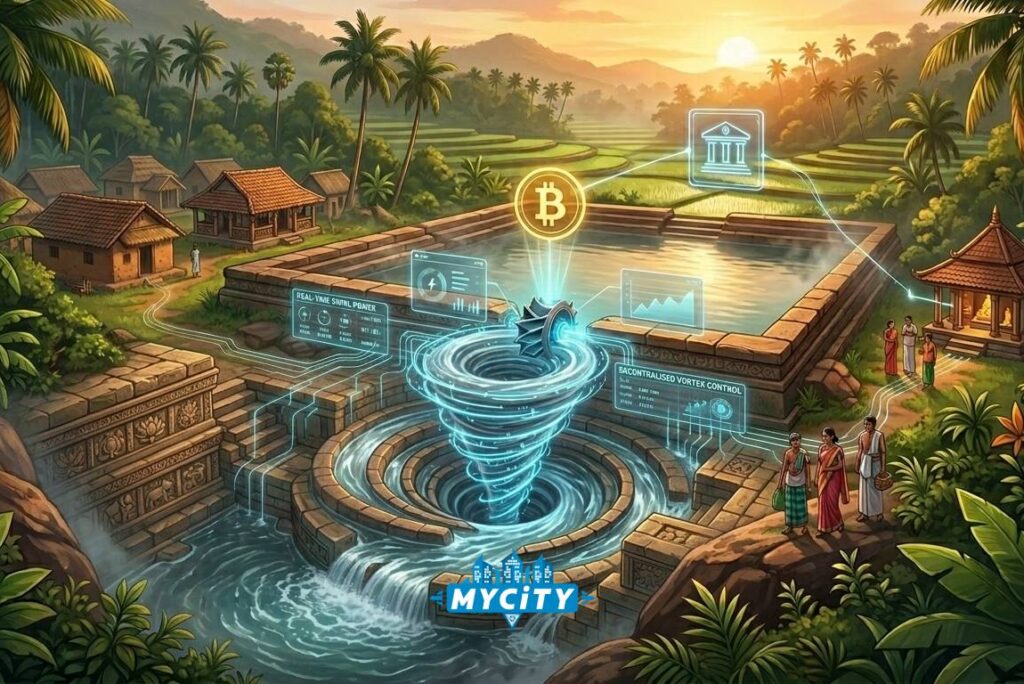
The economy is a leaky pipe, and taxation is just the mop
Every industrial-age economy runs on the same basic architecture: value is produced at the edges, by the worker, the farmer, the small business, and funneled toward the center, toward shareholders, intermediaries, and institutions that never touched the soil or the machine. Somewhere along that journey, most of the value is lost. Lost to rent-seeking. Lost to layers of bureaucracy. Lost to hoarding, where capital sits idle in offshore accounts instead of circulating back into the communities that generated it.
This is the leaky pipe problem. Money flows in at one end, full of promise, and arrives at the other end depleted, having paid tolls to everyone except the people who actually built the value in the first place. The worker becomes a "worker bee," optimized for output, disconnected from ownership, trading decades of labor for a wage that is quietly eroded by inflation every single year.
Governments, watching this leak happen in real time, are left holding a mop instead of a wrench. They cannot fix the pipe, so they tax the symptoms: carbon taxes to slow pollution nobody was incentivized to prevent, VAT hikes to plug deficits caused by leakage upstream, inflationary monetary policy to paper over systemic bubbles that the leaky pipe itself created. Taxation, in this model, is not a tool of nation-building. It is coercive triage.
The uncomfortable truth: A government doesn't tax you because it wants to. It taxes you because the underlying economic plumbing is broken, and taxation is the only lever left to keep the whole structure from collapsing. Fix the plumbing, and the lever becomes unnecessary.
// The architecture
A city where damaging the system is financial self-sabotage, not a crime
MyCity's model collapses the leaky pipe into a closed loop. In a P2P city, the resident isn't just a taxpayer or an employee. The resident is the worker, the company owner, and the citizen, simultaneously. There is no separate class of distant shareholder extracting value from the bottom of the pipe, because the people at the bottom of the pipe are the same people holding equity at the top.
This single structural change rewires incentives at the deepest level. In a centralized system, polluting a river or neglecting a shared resource is an externality, a cost pushed onto someone else, policed after the fact by an inspector with a fine book. In a tokenized, circular village economy, the river, the field, the grid, and the turbine are the actual collateral behind your token equity. Degrade the ecosystem, and you are not risking a fine. You are directly devaluing the asset you own a percentage of.
Suddenly, regulation becomes unnecessary because self-interest and ecological stewardship point in the same direction. You don't need a coercive tax authority to make people behave responsibly when responsible behavior is simply the most profitable thing they can do with their own stake.
// The starting point
Why we don't start in the city, we start in the village
You cannot retrofit a hyper-metropolis overnight. The legacy infrastructure, the legacy debt, and the legacy mindset are too entrenched. Instead, MyCity is leapfrogging the old economy at its weakest point of resistance: the rural sector, where land, water rights, and community trust are still intact, and where the cost of building new, parallel infrastructure is a fraction of what it would be inside a capital city.
The first node in this network is not a financial district. It's an Education Village, because the real bottleneck to a circular economy was never engineering. It was consciousness. Decades of hyper-competitive, scarcity-driven conditioning have to be gently undone before a community can hold a token economy responsibly. The Education Village exists to de-program the worker-bee mindset and re-introduce balance, essentialism, and a felt understanding of circular value, before a single coin moves through the system.
"You cannot upgrade the protocol of a city while its people are still running the operating system of scarcity."
// The 2,000-year head start
The blueprint already exists, it's called the Purana Gama
Here is what should stop you in your tracks: this model is roughly 90% already engineered. Not in a whitepaper. In the soil of Sri Lanka, for over two thousand years, in the form of the Purana Gama, the ancient village system built around four interlocking pillars: Wewai, Keth Yaya, Gammadda, and Pansala.
Our ancestors had already solved decentralized, self-sustaining resource governance at civilizational scale, long before the words "decentralized" or "tokenized" existed. We are not inventing a new system. We are simply giving the old one a wallet address.
The Wewa, the cascading tank system that captured monsoon rain and released it village by village, downstream, on a precise schedule, is functionally identical to an automated liquidity protocol. The Keth Yaya, the paddy fields fed by that cascade, become an IoT-monitored autonomous production layer. The Gammadda, the residential cluster that governed water rights and labor-sharing by consensus, is a Peer-to-Peer Governance DAO that already understood quorum and stake before either word was coined. And the Pansala, the temple at the center of village life, is reborn as the Education Village: the place where the mindset shift happens first.
// The R&D breakthrough
The Bisokotuwa: ancient hydraulic engineering meets the modern micro-turbine
Buried inside the Wewa system is a piece of engineering so advanced that modern hydrologists still study it: the Bisokotuwa, a valve pit designed to dissipate the destructive force of water flowing under high pressure from the tank, without eroding the downstream channel. It is, in essence, a 2,000-year-old energy dissipation chamber.
Our R&D team's contribution is deceptively simple: that dissipated energy was never captured, it was thrown away as turbulence. We integrate low-head micro-turbines, vortex impellers and small Kaplan-style units, directly into the existing Bisokotuwa structure. The water still flows exactly as it always has, irrigating the same fields on the same schedule. But now, as it passes through the valve pit, it spins a turbine on its way down.
Non-destructive by design: The turbine doesn't compete with irrigation. It harvests energy from the pressure that the Bisokotuwa was already built to destroy. We're not adding a new dam. We're not damaging a heritage structure. We're capturing waste.
// The economic capacitor
Bitcoin: turning stranded water energy into a sovereign budget
Here's the part that makes a tax collector unnecessary. At night, and during off-peak irrigation hours, the village still needs water to flow for pressure regulation, but nobody needs the electricity that flow generates. That energy has nowhere to go. It is, in energy terms, stranded.
Instead of wasting it, the Bisokotuwa's micro-turbines route that stranded energy directly into Bitcoin mining hardware, Proof-of-Work computation that converts raw, otherwise-wasted electricity into a globally liquid, censorship-resistant hard asset. The village isn't speculating. It is doing what gravity-fed irrigation has done for two millennia: converting moving water into stored value, just on a faster, harder, more portable rail.
[ WEWA / GRAVITY FLOW ]
        │
        ▼
night & off-peak release
        │
        ▼
[ BISOKOTUWA + MICRO-TURBINE ]  ← stranded energy harvested
        │
        ▼
[ BITCOIN MINING / PROOF-OF-WORK ]
        │
        ▼
[ DAO TREASURY ]  ← hard-asset village budget
        │
        ▼
[ VILLAGE INFRASTRUCTURE ]
   Starlink · sensors · school · clinic
        │
        └──────────────► back to [ KETH YAYA / FIELDS ]
                          cycle repeats, no tax collector required
That treasury, accumulated in an asset that no local currency depreciation can quietly erode, becomes the community's native funding mechanism. Starlink connectivity, soil sensors for the Keth Yaya, school supplies for the Pansala, clinic equipment, all of it paid for not by a tax bill, but by the mechanical byproduct of water doing what it was already doing.
// From rainfall to village budget, the complete cycle
Wewa Cascade
Monsoon rain is captured and released downstream on a precise gravity-fed schedule, exactly as it has been for centuries.
Bisokotuwa Turbine
Pressure that was historically dissipated as turbulence is harvested by a low-head micro-turbine, no new dam, no new disruption.
Bitcoin Mining
Stranded off-peak energy is routed into Proof-of-Work mining, converting kinetic water energy into a globally liquid hard asset.
DAO Treasury
Mining proceeds accumulate in a community-governed treasury, transparent, auditable by every resident, and immune to inflationary erosion.
Village Infrastructure
The treasury funds connectivity, sensors, education, and healthcare, the budget the village would have otherwise needed a tax authority to provide.
We didn't replace the ancient system. We completed it. The Wewa always knew how to move value through a community without a middleman, it just needed a ledger and a turbine.
Every layer of the Purana Gama, the tank, the field, the cluster, the temple, was already a decentralized protocol waiting for its digital counterpart. By starting small, in a single Education Village, and proving that water can mine its own budget, we build the template for a city that never needed a tax collector in the first place.
// Side by side
Leaky pipe vs. closed loop, the comparison
// Common questions
Frequently asked questions
-
What is the Purana Gama Protocol?
It's MyCity's framework for rebuilding the ancient Sri Lankan village system, Wewa, Keth Yaya, Gammadda, and Pansala, as a modern, tokenized, closed-loop economy where infrastructure is funded by native energy production instead of taxation.
-
Why does this start with a village instead of a city?
Rural land, water rights, and community trust structures are still largely intact, which makes it far cheaper and faster to build new, parallel infrastructure than to retrofit an entrenched metropolis. The Education Village is the proof-of-concept node before the model scales.
-
What exactly is the Bisokotuwa?
It's an ancient valve pit within the Wewa tank-cascade system, engineered to safely dissipate the pressure of water released from the reservoir without eroding the channel. MyCity's R&D integrates low-head micro-turbines into this existing structure to harvest energy that was previously wasted as turbulence.
-
Why route the energy to Bitcoin mining specifically?
Off-peak and nighttime water flow generates electricity nobody is using, stranded energy. Bitcoin mining is uniquely able to monetize stranded, intermittent energy anywhere on earth, turning it into a globally liquid, censorship-resistant asset that funds the village treasury without depending on any external government or currency.
-
Does this really eliminate the need for taxation?
Within the closed loop, yes. Because the same water that irrigates the fields also funds the budget through mining proceeds, the community doesn't need an external coercive collection mechanism to pay for shared infrastructure. The system funds itself by design, the way the Wewa always has.