
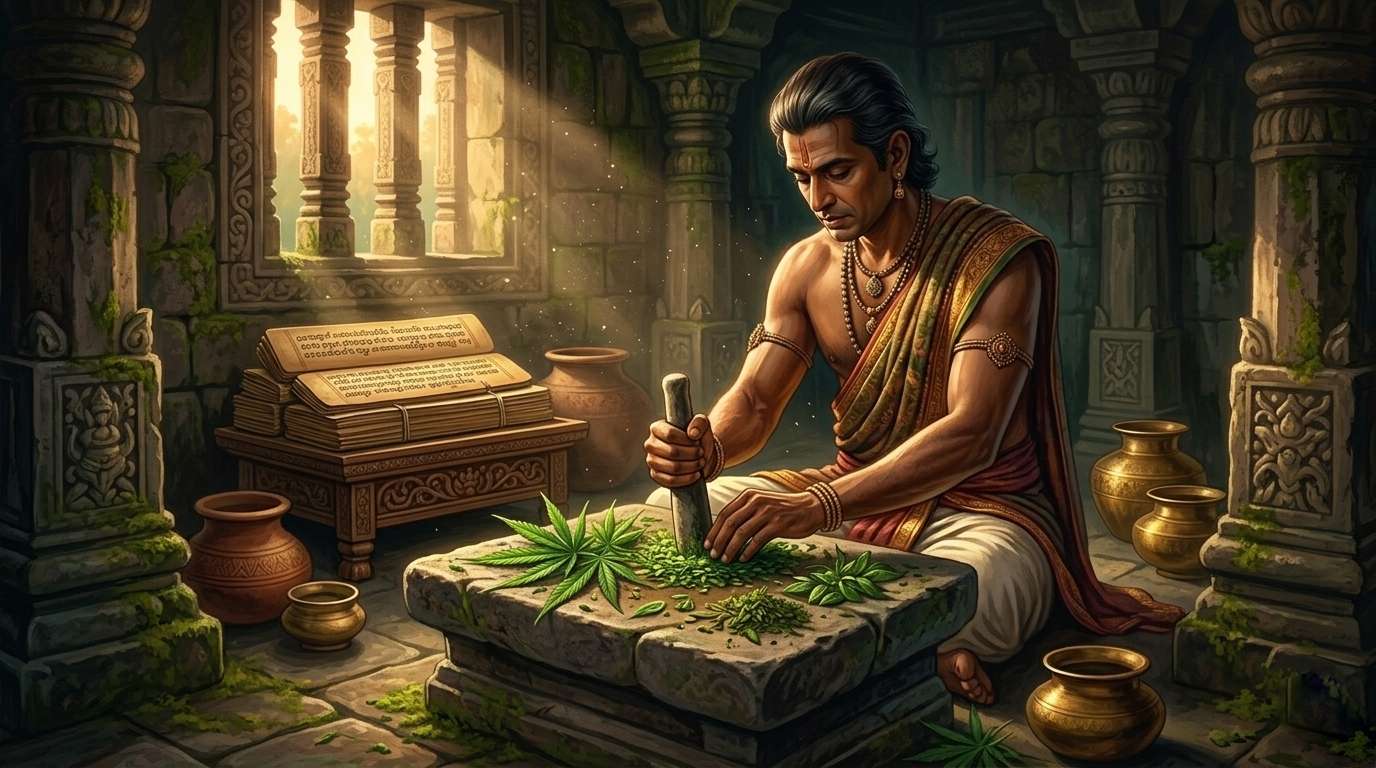
Long before "CBD," there was Sarartha Sangrahaya
Sri Lanka's relationship with cannabis isn't folklore, it's textbook. The Sarartha Sangrahaya, a foundational Ayurvedic medical text traditionally attributed to King Buddhadasa, who reigned in the 4th century AD, documented the plant's medicinal applications as part of the island's formal pharmacopeia. This wasn't a home remedy passed quietly between villagers, it was royal-sanctioned medical literature, sitting alongside treatments for fevers, wounds, and digestive ailments.
Cannabis was woven into Deshiya Chikitsa (the indigenous Sri Lankan medical tradition) and the broader Ayurvedic system, used by physicians who treated it the way a modern doctor treats a regulated pharmaceutical: with dosage, purpose, and respect.
The names they gave it tell you everything
You don't give a "dangerous narcotic" five different reverent, poetic names across Sanskrit and Sinhalese medical literature. You do that for a plant you respect.
Worth sitting with: A plant doesn't get called "bliss" and "desired in three worlds" by accident. These names survive in classical texts today, language doesn't lie about how a society actually felt about something.
// How it was actually used
Sacred medicine, not a street drug
This is the part colonial narratives conveniently erased: cannabis in pre-colonial Sri Lanka was never positioned as recreational intoxication. It was functional medicine, prescribed for specific complaints recognized in Ayurvedic theory, most notably to pacify Vatha Dosha (the bodily "air" energy associated with anxiety, insomnia, and digestive imbalance in Ayurvedic medicine), stimulate appetite, treat insomnia, and aid digestion.
One of the clearest pieces of evidence: Madana Modaka, a traditional herbal preparation, medicinal balls or lozenges that combined cannabis with other botanicals into a dosed, edible remedy. This is not how a culture treats a vice. This is how a culture treats a controlled, intentional medicine, the 4th-century equivalent of a regulated tincture.
"Same intent, sixteen centuries apart: a dosed, prepared remedy, not a vice."
// Who actually criminalized it
The colonial timeline: four laws, four foreign powers, zero Sri Lankan consent
Sri Lanka's 2,000-year relationship with this plant wasn't eroded by gradual cultural change, it was legislated out of existence by foreign occupying governments, one ordinance at a time.
The Dutch colonial administration (VOC) prohibits narcotic trafficking on the island, the first foreign legal intervention into a substance that had been domestically integrated into medicine for over a millennium.
Under British colonial rule, this ordinance taxes and restricts cannabis ("bhang") alongside opium, folding a native medicinal plant into the same regulatory bucket as imported narcotics sold for colonial revenue.
The British tighten control further, importing legal frameworks designed for British India and applying them to Ceylon, formalizing cannabis as a controlled substance under colonial law.
The final blow. Cannabis is folded into a sweeping ordinance grouping it with poisons and dangerous narcotics, completing its transformation from "Virapati, the hero-leaved" to "dangerous drug." This 1935 framework remains the legal DNA of how Sri Lanka treats cannabis today.
The pattern: Notice what doesn't appear anywhere in this timeline: a Sri Lankan Ayurvedic physician, a Sinhalese king, or a local community petitioning for these restrictions. Every law here was authored by a foreign colonial administration, enforced on a population that had used this plant medicinally for over a thousand years before any of these governments existed in Ceylon.
// The reversal nobody talks about
While Sri Lanka was told to be ashamed, the West built an industry on the same plant
Here's where the story turns from historical injustice into something closer to absurd. The exact plant a 1935 British ordinance criminalized into shame on Sri Lankan soil is now one of the fastest-growing legal industries in the nations that colonized us.
And the cruelest irony sits in plain sight today: Sri Lankan Ayurvedic physicians, practicing a legally recognized medical tradition that includes cannabis-based formulations like Madana Modaka, are often forced to rely on degraded cannabis seized from police raids to legally produce traditional medicines, because the plant their own pharmacopeia documented in the 4th century is still legally treated as contraband in the 21st.
Sit with this one: A Sri Lankan Ayurvedic doctor today may have to ask the police for confiscated plant matter to legally practice medicine their own ancestors wrote into a royal pharmacopeia 1,600 years before colonization. Meanwhile, dispensaries in countries that once ruled over Ceylon report billions in annual tax revenue from the same plant.
This was never a drug story. It was an ownership story, and Sri Lanka lost ownership of its own medicine the moment a foreign legislature decided it.
The Kansa of the Sarartha Sangrahaya and the cannabis now traded on Western exchanges are the same plant, separated by nothing but who got to write the law. Reclaiming that history isn't advocacy for a substance, it's correcting a 90-year-old narrative that told an entire nation to be ashamed of 2,000 years of its own documented medical knowledge.
// Common questions
Frequently asked questions
-
Was cannabis really legal and respected in ancient Sri Lanka, or is this exaggerated?
The documentation is specific, not vague folklore: a named royal-era text (Sarartha Sangrahaya, attributed to King Buddhadasa, 4th century AD), specific Sanskrit/Sinhalese terminology, and named preparations like Madana Modaka. This level of textual and linguistic detail is consistent with formal medical use, not casual or undocumented tradition.
-
Who specifically made cannabis illegal in Sri Lanka?
A sequence of foreign colonial administrations: the Dutch in 1675 (narcotics trafficking ban), then the British across three ordinances, 1867, 1905/1907, and the decisive 1935 "Poisons, Opium and Dangerous Drugs Ordinance," the legal ancestor of current Sri Lankan cannabis law.
-
Is this article advocating for recreational legalization?
No, this is a historical and cultural argument, not a policy prescription. The factual record shows a 2,000-year medicinal tradition that predates colonial law by well over a millennium, and a legal framework imposed by foreign powers in the 19th and 20th centuries. What Sri Lanka chooses to do with that history going forward is a separate, live policy conversation.
-
Can Ayurvedic practitioners legally use cannabis in Sri Lanka today?
Ayurvedic medicine is a recognized medical tradition in Sri Lanka, but cannabis remains controlled under laws descended from the 1935 ordinance, which creates significant friction for practitioners attempting to use a documented, traditional component of their own pharmacopeia.