
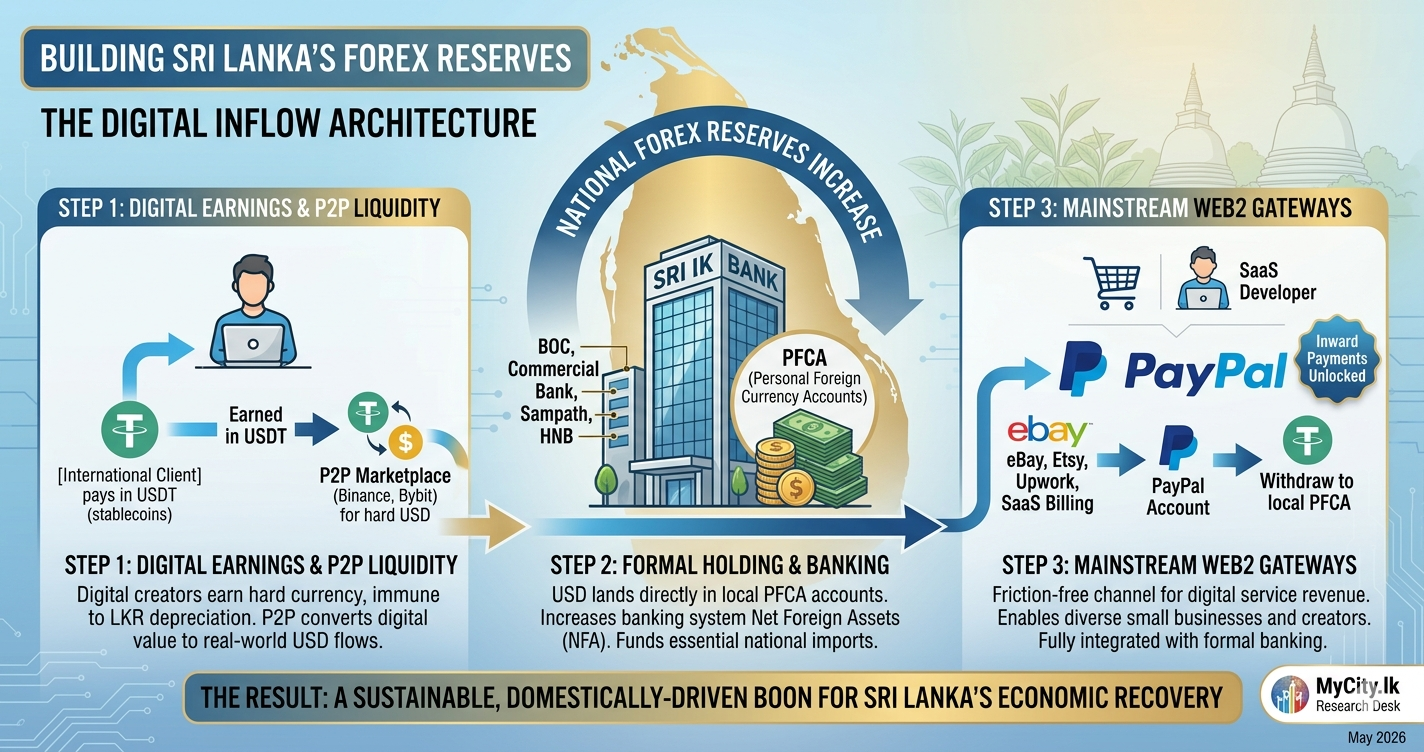
As Sri Lanka works through its post-crisis recovery, policy debate has centered on the traditional pillars of foreign exchange: remittances, exports and tourism. They remain foundational. But a new category of fast, digitally native dollar inflow has emerged that Sri Lanka has yet to harness systematically.
Three instruments sit at the center of this opportunity: USDT peer-to-peer trading as a liquidity mechanism, Personal Foreign Currency Accounts (PFCAs) as the formal place to hold dollars at home, and PayPal as the mainstream gateway for digital service revenue. Together they form a three-layer pipeline that can channel global USD directly into Sri Lanka's banking system.
// Section 01
The USDT P2P engine: a new inflow mechanism
Peer-to-peer USDT trading has grown from a niche activity into an efficient cross-border settlement tool. For Sri Lankan developers, designers, content creators and traders who earn from abroad, being paid in USDT offers something the local banking system cannot: immediate protection from LKR depreciation and a direct line to global dollar liquidity.
How the digital dollar economy arbitrage works
When a Sri Lankan freelancer earns USDT from an international client and sells it on a P2P marketplace to a global buyer who needs stablecoins, the mechanics look like this:
- Hard USD enters Sri Lanka through a formal banking channel.
- Net foreign assets improve for the banking system.
- No forced LKR conversion at the bank's buy rate.
Traditional remittance channels charge fees and often convert incoming money to LKR at the bank's rate. A P2P settlement keeps the value in hard currency: the Sri Lankan earner acts as a liquidity provider to the global stablecoin market and gets paid in dollars that can be banked formally.
Digital earners avoid two costs at once: the risk of LKR depreciation between earning and converting, and the fees traditional wire services charge. USDT earned abroad and sold P2P to international buyers ends up as clean USD in a formal account, without an intermediary taking a cut.
// Section 02
PFCAs: the formal holding infrastructure
Bringing dollars into the country is only half the equation. Keeping them inside the domestic banking system is what moves the needle for national reserves, and that is the job of the Personal Foreign Currency Account.
When P2P proceeds or freelance payouts are routed by SWIFT into a PFCA at a bank such as Bank of Ceylon, Commercial Bank, Sampath Bank or HNB, the benefits cascade:
// Section 03 · 2026 update
PayPal in Sri Lanka: the gateway finally opened
When this article first appeared, Sri Lankans could send money through PayPal but could not receive commercial payments, a bottleneck that pushed a whole category of digital work through third countries or informal channels. That changed in May 2026. After more than a decade of discussion, PayPal's service for receiving international payments launched in Sri Lanka in mid-May, with Bank of Ceylon, Commercial Bank and Sampath Bank as the first banking partners and more banks expected to follow.
Freelancers, start-ups, SMEs and digital exporters can now invoice global clients through PayPal and receive the money into a local bank account, under Central Bank regulation. The Central Bank expects the service to strengthen regulated foreign exchange inflows and make digital income more transparent.
The opportunity now shifts from access to retention. Every payout that stays in dollars inside a Sri Lankan account, rather than being converted immediately or parked abroad, does the most for national reserves. The groups that benefit first:
Running a Sri Lankan business that sells to foreigners? A website that ranks and takes payments is the other half of the pipeline; our web design and SEO service builds exactly that.
// Section 04
The macro equation: rebuilding forex reserves
The case for a digital dollar pipeline can be modeled simply. Treat digital service revenue as a separate inflow variable that policy can expand, alongside the traditional ones.
// National forex reserve change model

ΔFX = (R_t + R_d + Exports) − (Imports + Debt service)

ΔFX      net change in foreign exchange reserves
R_t      traditional remittances from workers abroad
R_d      digital revenue: USDT P2P + PayPal + freelance PFCA inflows
Exports  tea, garments, tourism, other goods and services
The key insight is that Rd, digital revenue, is unusually elastic. Physical exports need infrastructure, logistics and good commodity prices. Digital services scale with skills and internet connectivity; they need no container ships, warehouses or tea auction luck. Formalizing the USDT → P2P → PFCA route adds a fast, low-infrastructure inflow that can grow without the capital spending traditional export growth demands.
// Section 05
A progressive regulatory vision
To capture this, regulation needs to move from friction toward formalization. The rules are now being written: in July 2026 the Cabinet named the Securities and Exchange Commission as Sri Lanka's regulator for virtual assets, and a framework with mandatory registration, reporting and taxation is being drafted alongside the Central Bank, the Financial Intelligence Unit and the Inland Revenue Department.
"Embracing global decentralized liquidity is not about replacing local banking. It is about building high-speed on-ramps that channel global USD into domestic reserves."
The priorities, in order:
With the SEC's crypto law still in draft, this is the moment to shape it toward formalization rather than restriction, and to make Sri Lanka a jurisdiction that channels global digital liquidity into its reserves instead of pushing it further underground.
// Section 06
The path forward: Sri Lanka as a digital economic hub
Treat stablecoins as capital acquisition tools, PFCAs as national holding infrastructure and PayPal as the everyday consumer layer, and Sri Lanka can grow into a high-reserve digital hub without the heavy physical investment traditional development needs.
The talent is already here: a technically educated workforce, a diaspora connected to global markets and an established culture of freelancing and remote work. What has been missing is the regulatory architecture to formalize the flows these people already generate, and in 2026 that architecture is finally being built.
Make the formal channel the easiest channel, and reserves rebuild themselves.
Every digital earner who routes income through a PFCA strengthens their own position and the country's net foreign assets at the same time. The goal is not to mandate it but to make the formal path so smooth and rewarding that it becomes the obvious choice. When the formal channel wins on convenience and cost, the reserve picture improves on its own.
// Common questions
PFCAs, USDT and PayPal: frequently asked questions
-
What is a PFCA and which Sri Lankan banks offer it?
A Personal Foreign Currency Account lets Sri Lankan residents hold and receive foreign currency, mainly USD, in a local bank without compulsory conversion to rupees. Major banks including Bank of Ceylon, Commercial Bank, Sampath Bank, HNB and People's Bank offer them. Requirements vary, but usually include an NIC or passport and proof of the foreign source of funds.
-
Can Sri Lankans receive PayPal payments now?
Yes. PayPal's service for receiving international payments launched in Sri Lanka in mid-May 2026, with Bank of Ceylon, Commercial Bank and Sampath Bank as the first partner banks. Freelancers, start-ups and businesses can receive payments from abroad into local bank accounts under Central Bank regulation.
-
Can USDT P2P earnings be routed into a PFCA legally?
There is still no explicit rule either way. In July 2026 the Cabinet named the SEC as the regulator for virtual assets, and a law covering registration, reporting and taxation is being drafted. Until it passes, keep full records of every trade and the source of each SWIFT transfer, and check with your bank before routing P2P proceeds into a PFCA.
-
How do digital inflows compare to traditional remittances?
Worker remittances reached a record USD 8.07 billion in 2025, mostly from migrant workers abroad. Digital inflows through USDT, PayPal and freelance work are a complementary channel that does not require anyone to emigrate: a developer in Colombo can bring in the same hard currency as a worker overseas.
-
What is the hawala comparison?
Hawala, called undiyal in Sri Lanka, moves value through trusted brokers without money crossing borders officially. Informal USDT P2P channels are sometimes called a digital hawala because both sit outside the banking system. The policy goal is to give digital earners a formal, convenient alternative in PFCAs so that invisible value becomes banked capital.